
Gocrypto: Crypto Trading
Gocrypto: Crypto Trading & Investment SimulatorBusiness
4.56.04K Reviews
- Version
- 1.3.16
- Installs
- 10.00M
- Age Rating
- Mature 17+
Screenshots

Our Review of Gocrypto: Crypto Trading
 Analysis by Appyee
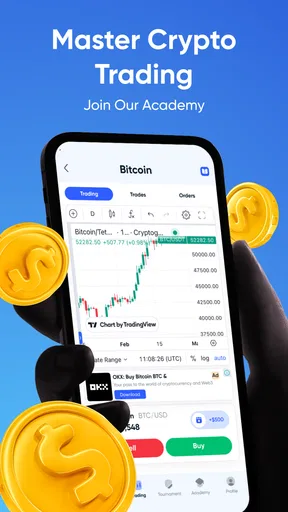
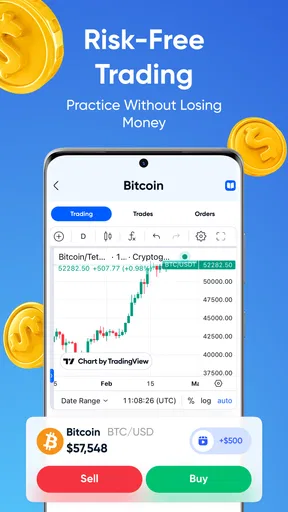
Crypto apps often make trading look easier than it feels. A moving chart, a buy button, and a few bold predictions can create the impression that confidence is enough. My experience with Gocrypto: Crypto Trading is more useful than that: it gives you a practice space where you can think through decisions without immediately putting money on the line. It is a free business app from Gocrypto: Crypto Trading & Investment Simulator, built around real-time simulations and challenges rather than direct access to a personal wallet.
I would not treat it as a shortcut to becoming a professional trader. I see it more as a structured rehearsal tool. You watch what is happening, decide what you would do, and learn how quickly a neat plan can become uncomfortable when the market moves against it. That makes it especially interesting for someone who keeps hearing about crypto but does not yet understand the rhythm of buying, holding, and reacting.
The app has attracted a 4.5 average from around 231 thousand ratings, with more than 10 million installs. Those figures suggest that it has reached a broad audience, but popularity is not the same as suitability. The important question is whether a simulated environment fits the way you learn. For me, its strongest value appears when I use it as part of a repeatable learning routine instead of opening it randomly whenever a price spike catches my attention.
Turning curiosity into a practical learning workflow
I use a simulator most effectively when I treat each visit as a small experiment, not a test of whether I can predict the market. Before starting, I choose one decision to examine and decide what evidence would change my mind. That simple boundary makes the practice easier to review afterward and helps keep a lively challenge from turning into aimless tapping.
What to do before opening the simulator
The best results start before the first virtual decision. I recommend choosing one narrow purpose for a session. For example, you might want to understand how a short-term move affects a position, compare patient holding with frequent reactions, or simply become comfortable reading the flow of a trading screen. Without that small goal, a challenge can turn into button pressing, and the result teaches very little.
I also find it helpful to write down a simple expectation before beginning: what I think the market might do, what would prove me wrong, and how long I intend to observe before changing direction. This is not about predicting perfectly. It is a way to separate a decision made in advance from a decision made because the latest movement feels exciting. A simulator becomes much more educational when it exposes that difference.
That preparation is where Gocrypto fits into a sustainable productivity system. I would not use it as a constant notification-driven habit. A short, deliberate session is easier to review than an entire evening of reacting to every change. If you are already prone to checking financial apps compulsively, setting a fixed time and a written objective matters more than chasing every available challenge.
Capturing decisions instead of trusting memory
One of the most useful habits is keeping a small trading journal alongside the app. Record the reason for a simulated action, the risk you thought you were accepting, and what you expected to happen next. Later, compare the result with the original idea. This reveals whether you are learning a repeatable process or merely remembering the wins and forgetting the impulsive choices.
A practical example is a commuter who has ten minutes before work. Rather than opening the app and making a fast decision, that person can spend the first minute reviewing yesterday’s note, use the next few minutes for one focused simulation, and finish by writing one sentence about what changed. The point is not to maximize activity. It is to make each visit answer a question.
This approach also helps with the limitation that simulated success can feel safer than real financial decision-making. A good result in a challenge may encourage confidence, but it does not automatically prove that the same reaction would be sensible with real money, fees, tax considerations, or emotional pressure. Notes preserve the reasoning, not just the outcome, so you can judge whether the lesson is actually transferable.
Organizing practice around real decisions
I prefer to organize sessions by decision type rather than by simply trying to complete as much as possible. One session can focus on entering a position, another on waiting, and another on deciding when an original idea no longer makes sense. This keeps the app from becoming a reflex game and makes the practice closer to the questions a beginner will eventually face outside a simulator.
The challenge format is useful here because it gives the session a boundary. Instead of staring at an open-ended market screen with no clear stopping point, I can approach a task with a beginning and an end. That structure is valuable for people who learn better through small experiments. It also makes it easier to discuss progress with a friend because you can explain the decision rather than simply saying that the market went up or down.
Still, I would be careful about treating challenge completion as a scoreboard of skill. A challenge can reward a particular outcome, while real trading requires handling uncertainty and accepting that a sensible decision may produce a poor result. The strongest use of the app is to review why an action was taken, not to collect victories as proof that you have mastered crypto.
A repeatable routine that avoids impulsive use
My preferred routine has four stages. First, I define one learning question. Second, I run a focused simulation and avoid changing the goal halfway through. Third, I write down the result and the emotional reaction it created. Finally, I decide what I would change in the next session. That last step turns the app from entertainment into a feedback loop.
For a beginner, repeating this routine a few times a week is more useful than opening the app many times in one day. The exact schedule should match your attention span, but the principle is consistent: practice, observe, review, and adjust. If a session leaves you more excited than informed, that is a sign to shorten it and spend more time on the review stage.
I also recommend separating learning sessions from conversations about real investments. If a friend sends a message saying that a particular coin is about to rise, do not let that message become the purpose of your practice. Use the simulator to examine your own assumptions, not to validate someone else’s confidence. This small boundary makes the app safer and keeps it aligned with education rather than hype.
The current version is 1.3.11, and the app runs on Android devices using version 8.0 or later. That makes it accessible to people who are not using a recent phone, although the experience will still depend on the device’s screen, speed, and connection. I would check compatibility before building a daily routine around it, especially if you use an older handset.
Where the workflow can fail
The first failure point is confusing fast feedback with deep understanding. A simulation can show an immediate consequence, but crypto markets involve broader issues that a practice session may not reproduce in the same emotional or financial way. If you finish a challenge feeling invincible, pause before carrying that confidence into a real exchange.
The second problem is overfitting your practice to one successful pattern. A beginner may discover that a certain approach works in several sessions and then repeat it without asking when it stops working. I find it more valuable to deliberately test the limits of an idea: what assumption must remain true, and what kind of movement would make the plan unsuitable? That question is less exciting than a win, but it produces better judgment.
Another weakness is that a simulator cannot remove the emotional difference between virtual and personal money. Losing a practice position may be frustrating, yet it rarely creates the same pressure as watching savings decline. This is why I would not use a strong simulated record as a reason to invest immediately. The app can help you understand mechanics and discipline, but it cannot certify your financial readiness.
There is also a risk of spending too much time on the activity itself. Challenges can make learning feel productive even when you are repeating familiar choices. To prevent that, I would set a stopping rule: end the session after answering the question you started with, whether the result was positive or negative. More screen time is not automatically more knowledge.
How it compares with ordinary alternatives
The usual alternative is reading articles or watching videos. Those formats are better for learning vocabulary, market concepts, and different viewpoints, but they can leave beginners passive. Gocrypto gives the learner a chance to make a choice and see a consequence, which is the part that many explanations cannot provide. I would use written material to understand an idea and the simulator to test whether I can apply it calmly.
Another alternative is opening a live exchange account. That offers a more realistic emotional experience, but it introduces financial risk before a beginner has developed a process. Gocrypto is the more sensible starting point for someone who wants to rehearse the sequence of observing, deciding, and reviewing without making the first lesson expensive.
On the other hand, an advanced trader may prefer detailed charting tools, portfolio tracking, order controls, and market research in a full trading platform. A challenge-focused simulator is unlikely to replace that kind of working environment. If your goal is managing an existing portfolio rather than learning the basics of decision-making, a dedicated exchange or analysis tool may be a better fit.
Paper notes and spreadsheets remain useful alternatives too. They force you to explain every decision and can reveal patterns over time. Their weakness is that they do not provide the same guided, interactive setting. I see the strongest combination as simple journaling plus Gocrypto: the app supplies the practice context, while the notes preserve the reasoning that the app alone may not make obvious.
Who should adopt it, and who should skip it
I would recommend Gocrypto to a curious beginner who wants to understand crypto trading before risking money, a student exploring financial decision-making, or an existing user who needs a disciplined way to examine impulsive habits. It is also suitable for someone who learns through short challenges rather than long technical explanations. The free price removes an obvious barrier to trying that approach.
The mature 17+ content rating is worth taking seriously. Younger users should not treat the app as a casual game, and adults should still frame it as financial education rather than a promise of income. The subject matter involves risk, and the simulated format can make risky decisions feel harmless if you do not keep that distinction visible.
I would skip it if you are looking for direct real-money trading, a complete investment portfolio, or professional-grade market analysis. I would also skip it if you know that challenges encourage you to chase wins, check constantly, or make decisions without reflection. In that case, a slower course, a spreadsheet, or a conversation with a qualified financial professional may serve you better.
My final view is that Gocrypto: Crypto Trading works best as a rehearsal room, not as a crystal ball. Its real strength is the combination of accessible practice, real-time simulation, and bounded challenges, especially when I add a written review after each session. Its main weakness is easy to understand: virtual decisions can feel convincing while leaving out the full pressure and complexity of real finance.
If you approach it with a question, a time limit, and a habit of recording why you acted, it can turn vague crypto curiosity into more careful thinking. If you approach it as a competition to win quickly, it may reinforce exactly the impulsive behavior that beginners need to avoid. For me, that distinction decides whether the app is worthwhile: use it to improve your process, not to manufacture confidence.
Released on June 17, 2024, it is still a relatively young app, but its broad adoption shows that the idea has found an audience. I would try it for free, keep expectations realistic, and judge it after several reflective sessions rather than after one lucky result. Used that way, it earns a place in a sustainable learning routine for crypto, while remaining clearly separate from the much more serious decision of investing real money.
Privacy and Permissions
See what permissions an app requests and how it handles your data.
- Wi-Fi connection information
- view Wi-Fi connections
- Other
- view network connections, full network access, run at startup, control vibration, prevent device from sleeping, Google Play license check
Verdict
Strengths of Gocrypto: Crypto Trading
- Simple interface suited to beginners learning crypto trading.
- Supports quick buying and selling of selected digital assets.
- Portfolio tracking makes it easy to monitor holdings and performance.
- Price information helps users follow market movements on the go.
- Useful for users who prefer managing trades from a mobile device.
Limitations of Gocrypto: Crypto Trading
- Cryptocurrency prices can change rapidly, creating a high risk of losses.
- Available coins and features may vary depending on your country.
- Trading fees and spreads can reduce returns on frequent transactions.
- Advanced charting and analysis tools may feel limited for experienced traders.
- Identity verification may be required before trading or withdrawing funds.
Similar Picks in This Category
View All
LinkedIn: Community & Network
LinkedIn3.8

Zoom Workplace
zoom.com4.1

Microsoft Teams
Microsoft Corporation4.6

Meta Business Suite
Meta Platforms, Inc.4.6

Webex Meetings
Cisco Systems, Inc.4.5

TeamViewer Remote Control
TeamViewer4.4
Frequently Asked Questions
What is Gocrypto: Crypto Trading, and what can I do with it?
Gocrypto: Crypto Trading is a mobile cryptocurrency platform designed for users who want to monitor digital-asset prices, explore market information, and manage crypto trading activities from a phone. After reviewing the app, its main appeal is the convenient access to market data and trading tools in one place. Available features may vary by country, account type, and supported assets.
Is Gocrypto: Crypto Trading suitable for beginners?
The app can be useful for beginners because it brings cryptocurrency prices, charts, and account functions into a mobile interface. However, new users should understand basic concepts such as market orders, limit orders, volatility, fees, and wallet security before trading. The application may simplify the process, but it does not remove the financial risks associated with buying or selling cryptocurrencies.
Is Gocrypto: Crypto Trading safe to use?
Security depends on both the platform’s protective measures and the way you manage your account. Before depositing funds, check whether the app supports features such as password protection, identity verification, two-factor authentication, and secure withdrawal controls. Never share login codes or recovery information, and download the application only from an official store or verified source to reduce the risk of counterfeit apps.
What fees or requirements should I check before trading?
Before using Gocrypto: Crypto Trading, review the current fee schedule carefully. Costs can include trading commissions, spreads, deposit or withdrawal charges, network fees, and possible conversion expenses. You may also need to complete identity verification and meet regional eligibility requirements. Fees, supported payment methods, minimum transactions, and available cryptocurrencies can change, so confirm the latest details inside the app or on its official website.
Can I withdraw my cryptocurrency or money from Gocrypto?
Withdrawal availability depends on the asset, your location, account verification status, and the payment or blockchain network selected. In the app, users should carefully check wallet addresses, network compatibility, processing times, and applicable charges before confirming a transaction. Cryptocurrency transfers are often irreversible, so verify every detail. If withdrawals are temporarily restricted, consult the platform’s support information rather than sending repeated transactions.
